Let's Honor the Empty Chairs During Disability Pride Month
Access barriers, both physical and bureaucratic, gravely diminish the quality of life of people with disabilities, often leading to death.

Trigger warning: Disability and death.
“There's a grief that can't be spoken
There's a pain goes on and on
Empty chairs at empty tables
Now my friends are dead and gone.”
— Marius Pontmercy, Les Misérables
As a child with spina bifida whose world was riddled with pain, uncertainty, and constant medical procedures, I sought great comfort in buying into the narrative that spina bifida is not a “terminal” condition.
And indeed, spina bifida is not an “illness,” nor is there technically a shortened lifespan associated with it. So, as a nerd who loved to read research and other literature on spina bifida to educate myself and feel empowered, it was an enormous relief to know that, thanks to many medical advances that have been made, I wouldn’t be short-changed on years of life due to my disability.
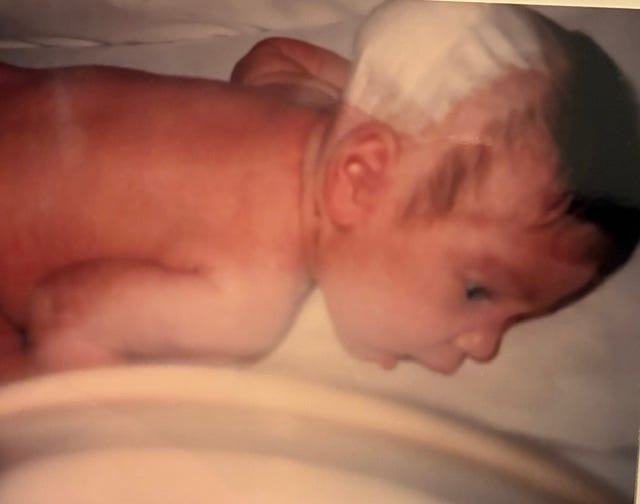
From the day I was born, I needed multiple surgeries to survive, including the placement of a shunt for hydrocephalus.
However, the past decade or so seems to tell a very different story. I am 39 years old now, and I have sadly lost count of the people around my age range with spina bifida who have tragically passed— many perhaps from preventable complications.
I was never entirely oblivious to my own mortality. I am painfully aware of an incident that occurred when I was five, thankfully already hospitalized. I was diagnosed with a urinary tract infection, and was watching TV in my room when I suddenly became unresponsive. My Mami tells me I went into septic shock while watching “Where in the World is Carmen Sandiego?”
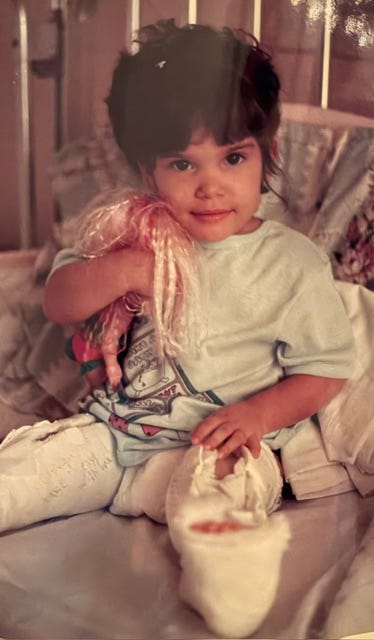
Me during one of my many hospitalizations as a baby and toddler in Puerto Rico.
It’s very difficult— excruciating, really— for me to imagine those next few moments. A code was called, a team of nurses and doctors rushed into my room, and eventually, a social worker was called to talk with my parents. I have carefully asked my parents questions about this scare over the years, knowing it causes them no small amount of pain to recall the details.
But I made it. I’m still here.
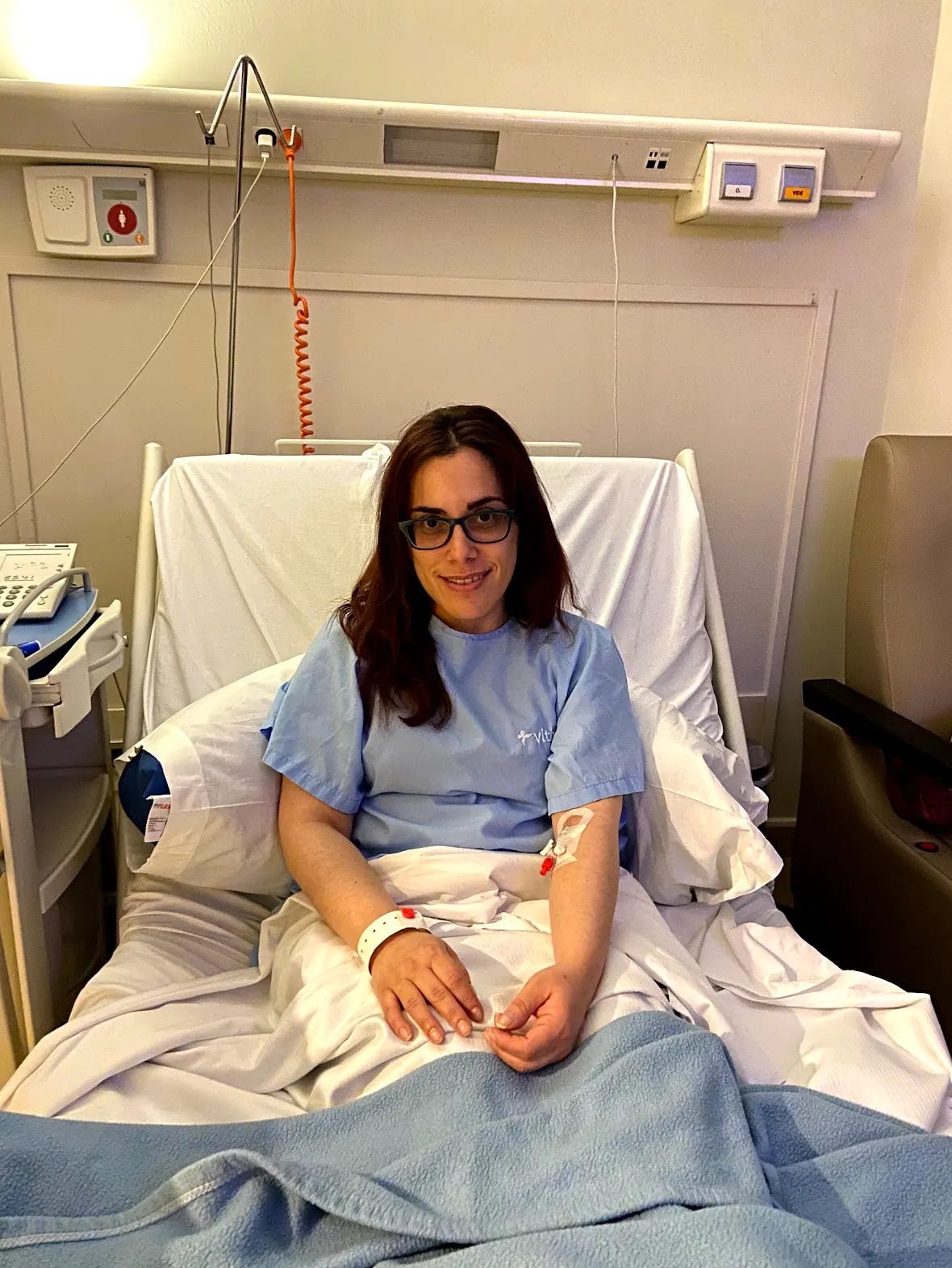
I was hospitalized multiple times in 2019, culminating in an unexpected hospitalization in Benalmádena, Spain.
So, I convinced myself that the most dangerous part of my life with spina bifida was behind me.
From a young age, I’d been taught about some of these dangers. I had to always be on alert if I had a urinary tract infection, or, since I have hydrocephalus, if I felt I had symptoms of shunt failure. In my case, many times these complications didn’t present with very aggressive symptoms, so I always had to be extra cautious and become familiar with my own body. And, as I never failed to remind doctors, no one knew my body better than me.
Now, I’m not even sure that’s true anymore.
It seems every few short months, I see an update in my social media feeds, or I receive a harrowing message from a friend in the spina bifida community: “One of us has died.”
I can’t even begin to explain the existential crisis this invariably catapults me into.
I’m not going to deny that I constantly feel a deep sense of gratitude that I am still here, still surviving if not thriving. But I also am plagued with a horrible guilt, guilt that the other person should still be here, guilt that I’ve “gotten away” with sometimes being a bit careless, for putting off that doctor’s appointment or exam.
Then again, who could blame me?
Life as an adult with spina bifida is ten times harder than when I was a kid with spina bifida.
Unlike when I was born, when my parents had access to so much information, specialists, support groups, and even a clinic that was specifically built for kids like us with all of the specialists we needed, navigating adulthood with a complex medical condition hits different.
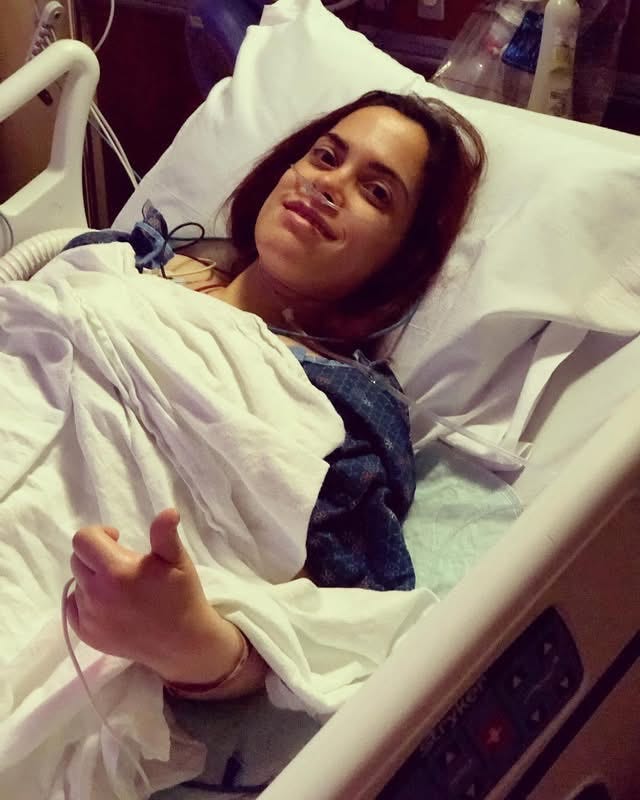
One of my multiple hospitalizations in 2019, all due to undiagnosed endometriosis.
I’ve long since aged out of all the pediatric specialists, and finding the adult specialists is no picnic. Some of the pediatric specialists, as they are often well-versed in treating patients with spina bifida, will keep us on for a bit longer. But eventually, those crucial ties are severed, and we’re left to wander wild, uncharted territory on our own.
I don’t know how long it took me to find doctors that would treat an adult like me in the fields of orthopedic surgery, neurosurgery, and urology. Some are hesitant to even touch us, as they are not “experts” in treating people with spina bifida.
There was a moment as a very young adult when it hit me— the medical community was not prepared for us to survive childhood. That’s why.
So, alas, we were left on our own to deal with all of the wonderful, typical side effects of becoming an adult— plus bladder infections, pressure sores, hydrocephalus, etc. Not to mention that we are more prone to developing clinical depression due to social isolation than our counterparts without spina bifida.
Fabulous.
It has also occurred that I have been misdiagnosed because of my spina bifida.
I was sick for most of 2019, culminating in my being hospitalized while vacationing in Spain over the holidays. So, I spent New Year’s Eve 2019 and January 1st of 2020 finally being told I had possible endometriosis. Often, doctors will look immediately at the initial diagnosis and ignore other potential causes of symptoms. In my case, I actually had surgery for my shunt three separate times because a neurosurgeon believed my symptoms were related to my hydrocephalus.
I’m done accepting it as something that “just happens.” I have been a lifelong believer in the power of awareness; that if we know more, we can do more.
I refuse to believe that our expected lifespan is 40.
What are perhaps some of the other factors contributing to the detriment of our health and well-being? Whether or not you want to hear it, the answer is, of course, bureaucracy.
In 2025, a mere 22.8 percent of people with a disability were employed, according to the U.S. Bureau of Labor Statistics. The unemployment rate of people with disabilities is double the rate of people without disabilities. Many people rely on employment in order to access health insurance, leaving many adults with disabilities stranded with very limited options. Not to mention, for people like me with spina bifida, this is the ultimate pre-existing condition, and many are denied insurance precisely because of this.
Contrary to popular belief, not every adult with a disability qualifies for supplemental social security benefits. And for those who do qualify, it’s not the bougie perk everyone seems to think it is.
According to a 2025 study by the CDC, 1 in 4 adults in the United States has a diagnosed disability. What’s more, percentages of adults with disabilities increased as poverty increased. “In fact, mobility disability was nearly 5 times as common among middle-aged adults living below the poverty level compared to those whose income was twice the poverty level,” the study reads.
There is a clear positive correlation between poverty and disability. However, there is a very vocal minority (or, who knows? Majority?) who believes we are not reaping what we’ve sown; that those of us with disabilities are not deserving of some help when the going gets rough. (But none of you mind watching content about a sweet raccoon with a shortened spine, right?)
Still, even if some of us (not me— I don’t qualify) have access to supplemental income because of an inability to work, tell me— who can actually survive on $700 a month? Factor in rent, meals, some medications or medical supplies, and other goods and services that are of vital importance to those of us with disabilities. Plus, not everyone can rely on others who live with them and can be of assistance.
It’s not as bougie as you thought, is it?
The reality is, since the system is set up to support people who are not earning a living wage to begin with, the very system punishes people who earn even the slightest bit outside of their monthly SSI check.
If you consider that having access to vital medical and orthopedic equiment is also a deterrent, you might be able to understand how so many of us are being failed by the system. I personally spent two years battling insurance and going back and forth with a mobility equipment company in order to obtain a functional new manual wheelchair. This was the same period of time when I was dropped from my urinary catheter provider, and it took me over a year to secure a new one.
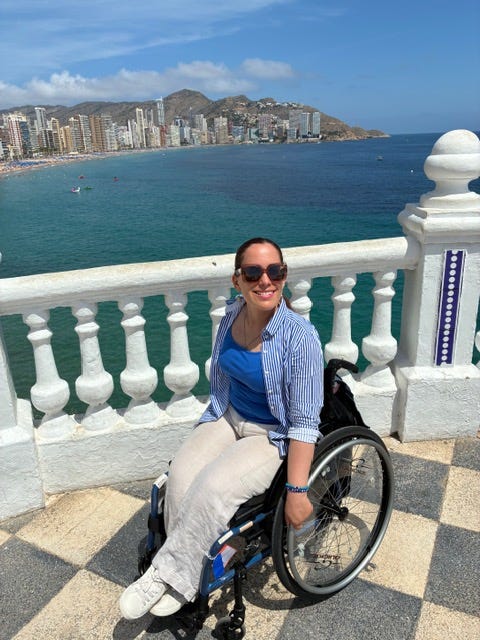
Me, finally enjoying my new wheelchair in Benidorm, Spain, after two years of fighting for repairs and accountability.
It hurts even more to know that something as normal as qualifying for Medicaid has become incredibly stigmatized in our culture, as if it’s somehow a failure on the part of the recipient that they need these services. Why is everything that is associated with disability and medical vulnerability seen as a weakness?
I know these are all things that are difficult to come to terms with, and it’s probably particularly uncomfortable for people outside the disability community to confront. But July is Disability Pride Month, and while I couldn’t be prouder of the activists, healthcare workers, caregivers, and individuals who advocate on a daily basis for our most basic, fundamental rights, I am not proud of our continued marginalization.
If a a society is to be judged by “how it treats its most vulnerable,” then I’m very sorry to say that our society has failed.
How do we honor the people we’ve lost? How do we mourn the people who have been failed?
We speak up. We advocate. We teach.
We can continue to enjoy the cute videos of animals with disabilities, like the currently ubiquitous Jimothy, who is adorable. But if we fawn over animals with disabilities, we must also speak up for humans with disabilities, who are consistently falling through the cracks of a system that was not built for our long-term survival. These lifelong conditions that were once regarded as “compatible with life” will become death sentences before long.
If we don’t speak up, we will continue to find many empty chairs at empty tables.